Career Paths in AI That Non-CS Students Can Start This Year
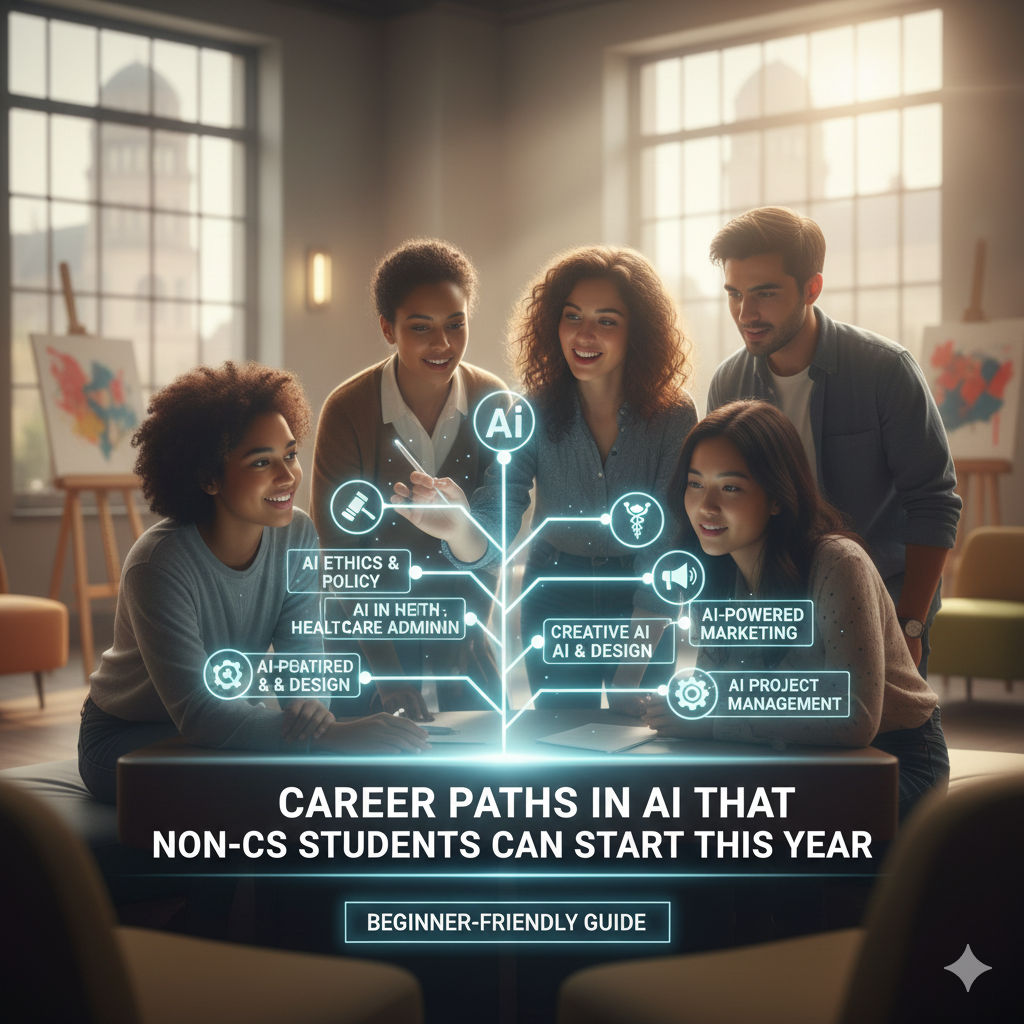
Career Paths in AI That Non-CS Students Can Start This Year
Keyword: ai careers for non cs students — Intent: Career Guidance
For a long time, “Artificial Intelligence careers” felt like something reserved only for computer science toppers, coding geniuses, or people who lived inside laboratories surrounded by complex equations.
But 2025 changed the game.
Today, companies are not just hiring AI engineers—they’re hiring people who understand human behavior, creativity, communication, business, psychology, healthcare, law, education, finance, design, and almost every other discipline… and can work alongside AI.
That means you don’t need a CS degree to start a career in AI.
In fact, some of the fastest-growing AI jobs right now are specifically designed for non-technical backgrounds.
Whether you're from commerce, arts, humanities, management, healthcare, law, design, or even social sciences—there is a path for you.
This guide breaks down everything you need to know to start this year.
Why Non-CS Students Are Becoming Essential in AI
Most people assume AI is “all coding,” but here’s the truth:
AI systems don’t just need coders—
they need domain experts, creative thinkers, communicators, researchers, and ethical decision-makers.
AI is becoming deeply human-centric, which means:
Businesses need storytellers to explain AI.
Hospitals need healthcare workers who understand AI reports.
Educators need tools to use AI with students.
Lawyers need to interpret AI regulations.
Marketers need to use AI for content and strategy.
Designers need to build AI-driven user experiences.
AI is not a technical-only world anymore.
It’s a collaboration between technology and every other field.
That’s exactly why you—without a CS degree—may actually be more in demand than you think.
Top AI Career Paths Non-CS Students Can Pursue in 2025
Here are the roles that are exploding in demand and require no hardcore coding to get started.
1. AI Prompt Engineer (All streams)
What you do
You design prompts, instructions, and workflows that help AI tools produce accurate, reliable results.
Why non-CS students fit
Prompt engineering needs creativity, writing ability, clarity, and specialized knowledge—not coding.
Skills you need
Good communication
Critical thinking
Understanding how AI tools behave
Ability to break problems into steps
Where it’s used
Marketing agencies
EdTech
Healthcare
Startups
Legal firms
HR and recruitment
How to start
Practice with ChatGPT, Claude, Gemini
Learn prompt patterns (role-based, chain-of-thought, multi-step)
Build a portfolio of solved tasks
This is one of the easiest and fastest-entry roles in AI.
2. AI Content Strategist / AI Writer (Arts, Media, Commerce)
AI has transformed content creation, but companies still need human strategy.
What you do
Use AI tools for research
Turn complex topics into simple content
Manage brand voice + ethics
Build content systems using AI
Skills you need
Writing
Understanding audiences
Creativity
Tool familiarity (ChatGPT, Jasper, Notion AI)
Why this is booming
Brands now produce 10x more content, and AI helps—but humans guide the strategy.
3. AI Business Analyst (Commerce, Management)
What you do
Use AI-based tools to read data
Create dashboards
Make business recommendations
Collaborate with technical teams
Skills you need
Basic analytics
Problem-solving
Understanding business models
Tools like Tableau, Power BI, and even ChatGPT data analysis remove the need for coding.
4. AI Product Manager (All streams, especially MBA students)
An AI product manager ensures that AI solutions actually solve real problems.
What you do
Understand user needs
Coordinate with developers
Create product roadmaps
Test AI features
Ensure ethical use
Why non-CS students can excel
Product management is more about decision-making and user understanding than technical skills.
5. AI Trainer / Data Annotator (Arts, Psychology, Linguistics, Social Science)
This is one of the biggest hidden job markets globally.
What you do
Label data
Teach AI models how to behave
Rate AI conversations
Train chatbots
Skills you need
Attention to detail
Logic
Language skills
Why it's perfect for beginners
Most roles don’t need advanced degrees—only accuracy and good judgment.
6. AI in Education (Teachers, B.Ed., BA, MA students)
This field is exploding because schools and colleges worldwide are adopting AI.
Career roles
AI-powered curriculum designer
AI learning coach
Chatbot-assisted teaching specialist
EdTech content developer
What you do
Use AI tools to:
Create lesson plans
Build student assessments
Generate notes
Provide adaptive learning pathways
Education + AI = one of the safest long-term careers.
7. AI Healthcare Roles (Nursing, Pharmacy, Bio, Psychology)
You don’t need to be a tech person to work in AI healthcare.
Job opportunities
AI medical assistant
AI diagnosis support specialist
Healthcare data annotator
AI mental health content specialist
What you do
Interpret AI-generated health data
Work with telemedicine tools
Assist in patient AI consultations
Support doctors with AI summaries
Healthcare + AI jobs are some of the most stable in the world.
8. AI Designer / UX Writer (Design, Arts, Media)
As AI tools get smarter, design roles are evolving.
Career options
AI UX writer
AI interface designer
Conversational designer
Voice assistant designer
AI chatbot personality creator
Skills you need
Storytelling
Understanding user emotions
Visual sense (for design roles)
Design is becoming one of the biggest AI-powered careers.
9. AI Ethics & Policy Roles (Law, Arts, Sociology, Political Science)
AI laws are being written worldwide—so experts are in high demand.
What you can do
AI policy analyst
AI governance advisor
AI compliance officer
Ethics reviewer
Bias and fairness evaluator
Why non-CS students are a match
Ethics, law, society, justice, psychology—these are humanities strengths.
This field will only grow in the next decade.
10. AI Marketing & Automation (Commerce, BBA, MBA)
Marketing is now the highest adopter of AI tools.
Careers include
Marketing automation specialist
AI-driven campaign strategist
Chatbot marketing expert
Social media + AI analyst
You don’t need coding
Tools like Zapier, HubSpot, and Grammarly do the heavy lifting.
11. AI Finance & Analytics (Commerce, CA, BBA, Economics)
AI is transforming finance more than any other industry.
Roles
FinTech AI specialist
AI risk analyst
Market prediction assistant
AI-supported investment advisor
Understanding finance + knowing how to use AI tools = high-paying combo.
12. AI Virtual Assistant Roles (All streams)
Perfect for beginners and freelancers.
What you do
Use AI tools to help clients with:
Scheduling
Research
Content
Data organization
Email management
Social media
There are thousands of openings on platforms like:
Upwork
Fiverr
RemoteOK
FlexJobs
A great place to start without heavy skills.
What Skills Do You Actually Need? (The Honest List)
You do NOT need:
❌ coding
❌ advanced math
❌ engineering expertise
❌ a CS degree
❌ expensive courses
You DO need:
✓ Curiosity
AI changes quickly—so you must enjoy learning.
✓ Creativity
AI can assist, but humans bring original thinking.
✓ Communication
Every AI job requires clarity—writing or speaking.
✓ Problem-solving
AI is a tool, and you must know how to use it correctly.
✓ Tool familiarity
ChatGPT
Gemini
Claude
Notion AI
Figma AI
Power BI
Excel AI
Just knowing how to use these properly makes you job-ready.
How to Start Your AI Career in 2025 (Step-by-Step)
Here is a simple, practical roadmap:
Step 1: Choose the role that fits your background
Not sure? Here’s a quick guide:
Arts → Content, design, ethics
Commerce → Finance AI, marketing AI, business analysis
Management → Product, marketing, operations
Healthcare → AI health assistant, medical annotation
Psychology → AI behavior analyst, training evaluator
Law → AI policy, governance, ethics
Education → AI teaching tools, curriculum developer
Step 2: Learn the basic AI tools
Spend 10 minutes daily on:
ChatGPT
Gemini
Claude
Notion AI
Canva AI
Perplexity
This builds comfort and confidence.
Step 3: Build 3 small projects
Examples:
A chatbot for students
A business workflow automated with AI
A content strategy plan using AI
A data report created with AI tools
A set of AI-enhanced notes
A mini course created with AI
These projects become your portfolio.
Step 4: Create a simple portfolio website
Use Notion, Canva, or a free site builder.
Show:
Your projects
AI tools you know
Your learnings
Portfolio > Certificates.
Step 5: Apply for internships & freelance projects
Platforms:
Internshala
Naukri
LinkedIn
Upwork
Fiverr
Start with small roles and move up.
Step 6: Keep improving
AI changes monthly.
So keep learning new tools and case studies.
Free AI Learning Resources for Non-CS Students
Here are the best beginner-friendly options:
Google AI Fundamentals
DeepLearning.AI short courses
HubSpot AI Academy
YouTube tutorials
OpenAI Learning Platform
LinkedIn Learning AI courses
Notion AI Learning Hub
You don’t need expensive bootcamps.
Career Growth & Salary Expectations (India + Global)
Here’s a realistic range (entry-level → experienced):
AI Prompt Engineer: ₹4 LPA → ₹20 LPA
AI Content Strategist: ₹3 LPA → ₹18 LPA
AI Product Manager: ₹10 LPA → ₹45 LPA
AI Business Analyst: ₹5 LPA → ₹25 LPA
AI Trainer / Annotator: ₹2.5 LPA → ₹12 LPA
AI Ethics / Policy Advisor: ₹8 LPA → ₹30+ LPA
EdTech AI Specialist: ₹3 LPA → ₹18 LPA
AI Healthcare Support: ₹3 LPA → ₹20 LPA
Non-CS roles can grow just as fast as technical roles.
Final Thoughts: AI Is Not a Tech Career Anymore — It’s a Human Career
You don’t need coding.
You don’t need a CS degree.
You don’t need to be a tech expert.
What you need is:
willingness to learn
curiosity
creativity
communication skills
and basic tool familiarity
AI careers are no longer about building AI—
they’re about using AI to solve real-world problems.
And non-CS students bring something powerful to the table:
real human insight.
Discover Premium Tools & Resources
Unlock exclusive access to premium productivity tools, trending resources, and expert recommendations curated just for you.