ChatGPT Alternatives That Are Better
The Top Contenders: ChatGPT Alternatives That Stand Out
We've scoured the landscape to bring you AI chatbots and tools that truly offer a distinct advantage over ChatGPT in various scenarios.
1. Claude (by Anthropic)
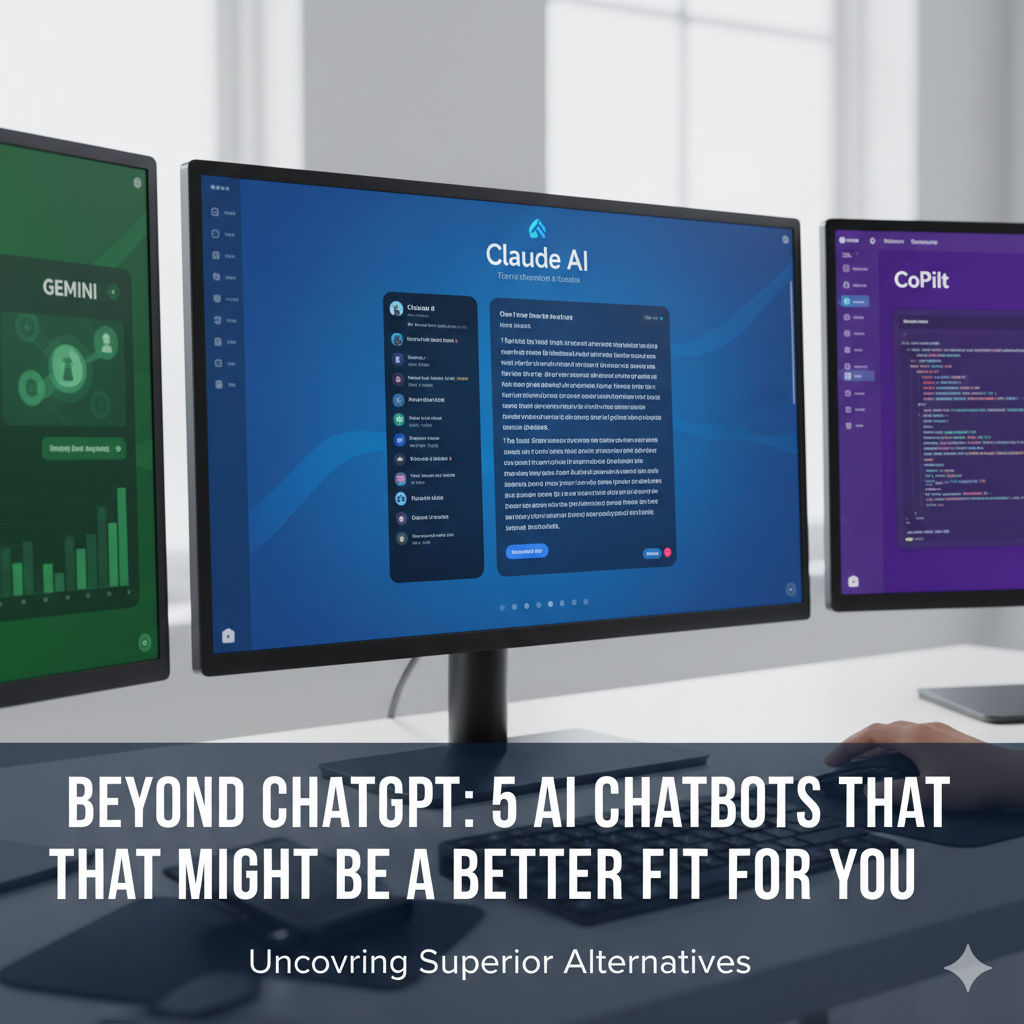
This image illustrates a desktop setup with multiple monitors, each displaying a different AI interface: Claude, Google Bard, and Jasper. The central monitor, featuring a stylized 'A' logo, is prominently showing the Claude AI interface with chat conversations. The overall aesthetic is professional and modern, focusing on the various AI tools in a workflow context.
If you're dealing with vast amounts of text, Claude often feels like a breath of fresh air. Developed by Anthropic, a company founded by former OpenAI researchers, Claude was designed with a strong emphasis on helpfulness, harmlessness, and honesty. This isn't just marketing speak; it genuinely impacts how Claude interacts.
What it Excels At: Claude boasts a significantly larger "context window" than many of its competitors. Think of it like its short-term memory – it can remember and process much longer conversations or entire documents (like a whole book chapter or a massive research paper). This makes it superb for summarizing lengthy content, deep analysis of complex texts, and maintaining coherent, extended discussions without losing its train of thought.
Key Features: Huge token limits (allowing for massive inputs), robust safety training to reduce harmful or biased outputs, and a generally more nuanced, less "canned" conversational style. It's often praised for its ability to perform detailed reasoning tasks.
Why it Might Be Better Than ChatGPT (for whom/what): If your work involves extensive reading, summarizing dense materials, writing long-form content that requires consistent tone, or intricate problem-solving where losing context is costly, Claude is a serious contender. It's particularly favored by researchers, legal professionals, and content strategists who need reliable long-form interaction.
Pricing Model: Offers both a free tier (with limitations) and more powerful paid versions (e.g., Claude Pro) for heavier usage.
2. Google Bard
It’s hard to talk about AI without Google entering the conversation, and their offering, Bard, is a powerful contender that addresses one of ChatGPT's common limitations: real-time information. Leveraging Google's vast search capabilities, Bard is designed to provide fresh, up-to-date responses.
What it Excels At: Getting current information. Unlike base models of ChatGPT that might have a knowledge cut-off date, Bard can pull directly from the web, making it excellent for news summaries, current event analysis, and queries that require the latest data. Its multi-modal capabilities are also growing, integrating seamlessly with other Google services.
Key Features: Direct access to Google Search for real-time information, often provides multiple draft responses for you to choose from, and is increasingly integrated with Google Workspace apps (like Docs and Gmail). It also excels at explaining complex topics in simpler terms.
Why it Might Be Better Than ChatGPT (for whom/what): If you frequently need an AI that knows what happened yesterday, last week, or even minutes ago, Bard is your go-to. It’s perfect for journalists, marketers needing current trend data, students researching recent events, or anyone who values immediate, relevant information from the broader web.
Pricing Model: Generally free to use, leveraging your Google account.
3. Perplexity AI
Think of Perplexity AI as the love child of a powerful search engine and an intelligent chatbot, but with a crucial distinguishing feature: it shows its work. For anyone who values accuracy and wants to verify information, Perplexity is a game-changer.
What it Excels At: Sourced answers and verifiable information. Every response from Perplexity comes with citations, linking directly to the web pages from which it gathered its data. This eliminates the "hallucination" problem common in many AI models and builds immense trust.
Key Features: Provides direct links to sources, offers a "Copilot" feature to guide your search process, and focuses heavily on providing accurate, research-backed summaries. It's also very good at breaking down complex topics into easily digestible formats while maintaining factual integrity.
Why it Might Be Better Than ChatGPT (for whom/what): If you're a student, researcher, journalist, or anyone who absolutely needs to cross-reference information and avoid misinformation, Perplexity AI is an indispensable tool. It transforms AI from a black box into a transparent research assistant.
Pricing Model: Offers a robust free tier with premium features available through a paid "Pro" subscription.
4. Jasper AI (and similar AI Writing Assistants)
While ChatGPT can write, tools like Jasper AI are purpose-built for content creation with a marketing and branding focus. These aren't just chatbots; they are comprehensive writing platforms.
What it Excels At: Generating high-quality marketing copy, blog posts, social media updates, ad copy, and even full-length articles with specific tones and styles. Jasper is designed to understand brand voice and produce conversion-focused content.
Key Features: Hundreds of templates for different content types, "Brand Voice" capabilities to ensure consistency, SEO integration (often with Surfer SEO), and features like "Boss Mode" for more advanced control.
Why it Might Be Better Than ChatGPT (for whom/what): For content creators, marketers, copywriters, and businesses that need consistent, high-volume, and brand-aligned written output, Jasper (and its ilk like Copy.ai, Writesonic) offers a specialized toolkit that far exceeds a general-purpose chatbot's capabilities. It streamlines workflows and helps maintain brand messaging.
Pricing Model: Primarily a paid subscription service, often with different tiers based on usage and features.
5. Specialized AI Tools (e.g., for Coding, Design, Data Analysis)
Sometimes, the best alternative isn't another general-purpose chatbot, but an AI specifically engineered for a niche. These tools don't try to do everything; they aim to do one thing exceptionally well.
What it Excels At:
GitHub Copilot: Code generation and auto-completion.
Midjourney / DALL-E: Generating stunning images from text prompts.
Tabnine / Codeium: AI code completion within IDEs.
Numerous AI Data Analysis Tools: Interpreting datasets, generating insights, creating visualizations.
Key Features: Hyper-focused functionalities, deep integration with specific professional software (IDEs, design suites), and highly optimized algorithms for their domain.
Why it Might Be Better Than ChatGPT (for whom/what): For developers, designers, data scientists, or anyone in a highly specialized field, a dedicated AI tool will almost always deliver superior results, efficiency, and accuracy compared to trying to force a general chatbot into a specialized role. These tools are built to speak the language of your profession.
Pricing Model: Varies widely, from free community versions to enterprise subscriptions.
How to Choose the Right AI for YOU: Your Personal AI Decision Guide
With so many powerful options, how do you pick the "better" one? It all comes down to your specific needs. Ask yourself these questions:
What's Your Primary Goal? Are you writing marketing copy, coding, researching current events, summarizing long documents, or just brainstorming? Your main use case should dictate your choice.
How Important Is Accuracy and Sourcing? If verifiable facts are paramount, tools like Perplexity AI or those with direct real-time access (like Bard) will be more suitable.
Do You Need "Real-Time" Information? If staying updated on current events or trends is crucial, an AI connected to the live web is essential.
What's Your Budget? Many tools offer free tiers, but premium features and higher usage often come with a subscription. Assess the ROI for your specific needs.
Does It Integrate with Your Workflow? An AI that seamlessly fits into your existing software (e.g., Google Workspace, your IDE, your CMS) will be far more effective.
How Much Context Do You Need? If you work with very long documents or complex, multi-turn conversations, look for AIs with large context windows (like Claude).
Conclusion: The Future Isn't One AI; It's Your AI Toolkit
The conversation isn't about finding a single AI to "replace" ChatGPT. Instead, it's about building a robust and diverse AI toolkit – a collection of specialized assistants that excel at different tasks. Just as a carpenter uses different saws for different cuts, the smartest approach to AI is to leverage the unique strengths of each platform.
Experiment! Dive into free tiers, test out different prompts, and see which AI truly resonates with your workflow and delivers the best results for your specific challenges. The AI landscape is evolving at lightning speed, and by exploring these powerful ChatGPT alternatives, you're positioning yourself at the forefront.
So, what's your take? Which ChatGPT alternative are you most excited to try, or which one has already become an indispensable part of your daily routine?
Discover Premium Tools & Resources
Unlock exclusive access to premium productivity tools, trending resources, and expert recommendations curated just for you.