Students & Learning: How AI Is Transforming the Way We Study, Learn, and Grow
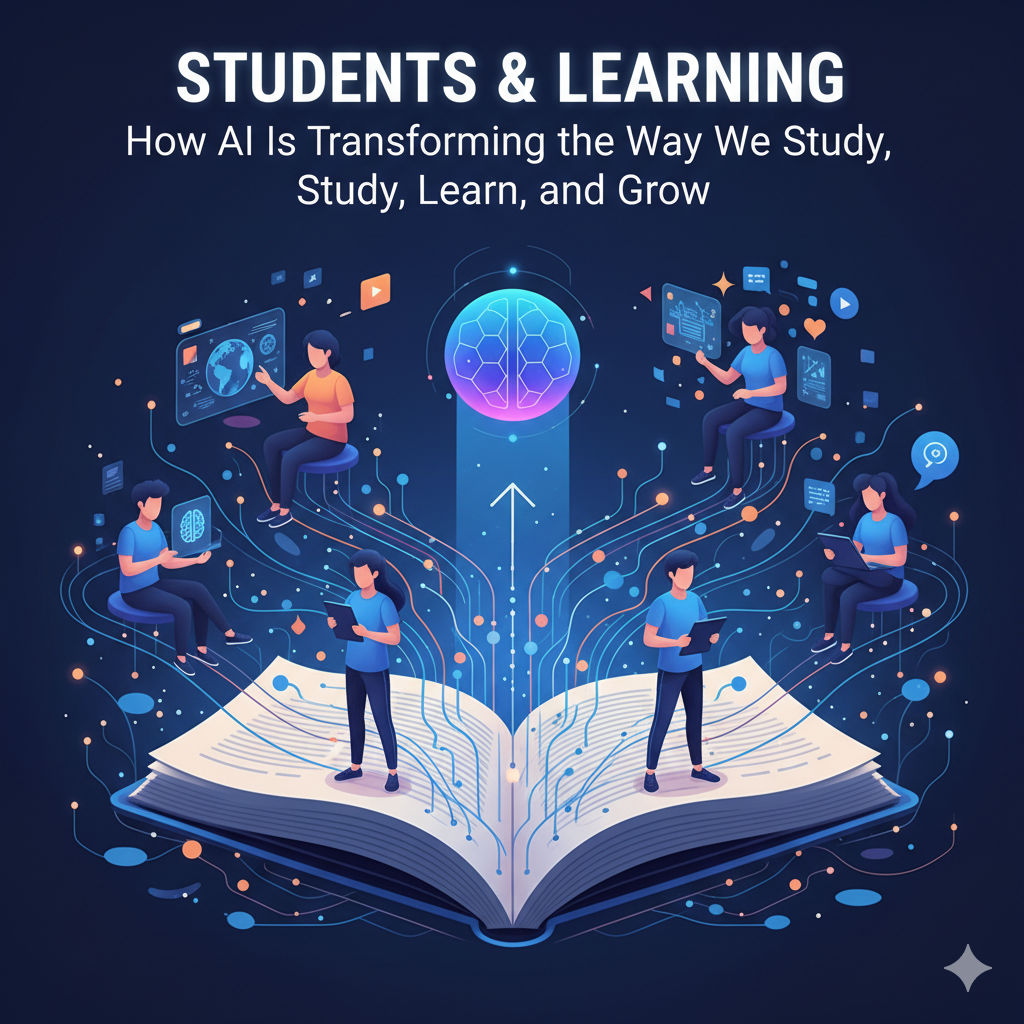
Students & Learning: How AI Is Transforming the Way We Study, Learn, and Grow
Keyword: students and learning
Intent: informational / educational
Education Is Changing — And So Are Students
Not long ago, learning meant carrying heavy textbooks, scribbling notes by hand, and relying on teachers or tutors for every bit of guidance.
Fast forward to today, and we’re in a completely different world.
From virtual classrooms to AI-powered study tools, the education landscape is undergoing a massive transformation — one that’s reshaping how students learn, how teachers teach, and how we all think about knowledge itself.
The truth is: AI isn’t replacing learning — it’s redefining it.
This article explores how modern students can use AI not just to make studying easier, but to learn smarter, faster, and more creatively than ever before.
1. The New Era of Learning: From Memorization to Understanding
In traditional classrooms, students were often judged by how well they could memorize information — dates, formulas, definitions.
But today’s world rewards a different skill: understanding how to apply knowledge.
AI tools are helping bridge that shift.
For example:
Instead of just reading about physics, students can use AI simulations to visualize how energy moves.
Instead of memorizing vocabulary, they can practice conversations with an AI language tutor.
Instead of guessing what they got wrong, AI learning platforms like Khan Academy’s Khanmigo or Quizlet’s Q-Chat now give instant, personalized feedback.
These tools push learning beyond rote memory. They encourage thinking, questioning, and exploring — the real ingredients of lifelong learning.
2. Personalized Learning: AI as Your Study Partner
One of the most powerful things about AI in education is personalization.
Every student learns differently — some are visual learners, some learn by doing, and some by listening.
Traditional classrooms often can’t accommodate those differences. But AI can.
Platforms like Duolingo, Coursera, and Edmentum use algorithms to track how well you perform, identify your weak areas, and adjust lessons accordingly.
It’s like having a tutor who knows exactly what you struggle with and gives you the right practice at the right time.
Imagine this:
You’re studying for an exam, and your AI study partner says,
“You tend to forget equations related to thermodynamics. Let’s spend 10 minutes revising that section.”
That’s not the future — that’s happening now.
And it’s transforming not just performance, but confidence. Students no longer feel lost in a sea of information; they’re guided step-by-step toward mastery.
3. Smarter Study Habits: Let AI Handle the Busywork
Let’s be honest — half of studying isn’t about learning.
It’s about organizing notes, summarizing chapters, creating flashcards, and managing time.
That’s where AI comes in as a productivity booster.
Here are a few ways students are using AI tools in 2025 to save hours every week:
Task | Traditional Way | AI-Powered Way |
|---|---|---|
Note-taking | Write by hand or type everything | Tools like Notion AI summarize and organize notes automatically |
Flashcards | Create manually | Quizlet generates them from uploaded text |
Summaries | Read long PDFs | ChatGPT or Scholarcy provides key points in seconds |
Research | Hours of Google searches | Perplexity AI or Elicit summarize verified academic papers |
By letting AI take care of the repetitive stuff, students can focus on what actually matters — understanding concepts and thinking critically.
That’s the beauty of this new learning ecosystem:
AI doesn’t do the learning for you; it gives you more time to learn.
4. Collaboration and Communication in the AI Age
Group projects and collaborations are part of every student’s life — and AI is making that process smoother, too.
Imagine using tools like Google Workspace AI, which can summarize team discussions, or Slack’s AI assistant, which highlights action items from meetings.
AI can even help break language barriers.
A team of students from India, Japan, and Spain can now collaborate using real-time translation tools — meaning ideas flow freely, regardless of native language.
Beyond academics, AI communication tools also prepare students for the future workplace, where hybrid teams and global collaboration will be the norm.
Learning to work alongside AI — not just use it — is now an essential 21st-century skill.
5. Critical Thinking Still Matters — Maybe More Than Ever
Now, let’s pause for a reality check.
AI can answer almost anything. But that doesn’t mean it’s always right.
That’s why critical thinking remains more valuable than ever.
Students need to question what AI says, verify facts, and learn to think independently.
For example:
When ChatGPT gives an answer, do you take it at face value? Or do you check the sources, analyze logic, and form your own conclusion?
That habit — of questioning and verifying — separates a smart user from a passive one.
Teachers are starting to adapt, too.
Instead of banning AI, many are now teaching “AI literacy” — how to use it responsibly, detect bias, and cross-check information.
In other words:
The future student doesn’t just consume information. They collaborate with it.
6. Emotional Intelligence and Human Learning
There’s one thing AI still can’t replicate: emotional connection.
Humans learn not only through logic but also through emotion — curiosity, motivation, empathy, and encouragement.
That’s why the best learning systems combine AI precision with human touch.
For instance, an AI tutor can guide a student through a complex math problem, but only a teacher or mentor can sense frustration, encourage resilience, and spark curiosity.
In classrooms, this balance is becoming more common:
AI handles grading and progress tracking
Teachers focus on mentorship, discussion, and creative learning
This blend is giving rise to what educators call the “hybrid classroom” — where humans and AI each play to their strengths.
7. Accessibility: Learning for Everyone, Everywhere
One of AI’s biggest impacts in education is accessibility.
Students with disabilities or limited access to resources are finally getting tools that help them learn at the same pace as everyone else.
For example:
Speech-to-text tools help students with dyslexia or visual impairments.
Translation AI breaks language barriers for non-native learners.
Adaptive learning systems adjust the difficulty level in real time, based on a student’s performance.
In developing countries, where teachers are often scarce, AI chatbots and virtual classrooms are filling the gap — bringing quality education to millions who might otherwise miss out.
That’s not just technology.
That’s inclusion in action.
8. The Rise of “AI-First” Students
A new type of learner is emerging: the AI-first student.
They’re not afraid of automation — they embrace it.
They use ChatGPT to brainstorm essays, Notion AI to plan study schedules, and Jasper or Grammarly to refine their writing.
But more importantly, they understand how to guide AI — using strong prompts, clear instructions, and context.
This is what we now call prompt literacy — a vital skill for the next generation of students.
By 2030, “prompt design” might be as common as essay writing was in the 2000s.
The ability to communicate effectively with machines — to express ideas clearly and guide outcomes — is quickly becoming one of the most important academic skills of our time.
9. Challenges: The Double-Edged Sword of AI in Learning
Of course, every innovation brings challenges.
Here are some of the biggest issues educators and students are facing:
A. Overreliance on AI
When students use AI to write every essay or solve every problem, they risk losing their analytical edge. AI is a tool — not a shortcut.
B. Data Privacy
AI platforms collect user data to improve performance. Schools must ensure privacy policies are transparent and compliant with laws like GDPR and COPPA.
C. Equity
While AI improves access, not all students have reliable internet or device access. Bridging this digital divide remains a priority.
D. Ethics and Originality
With generative AI, plagiarism detection becomes more complex. Schools must teach students how to use AI ethically — citing sources and acknowledging assistance.
These are not reasons to fear AI — they’re reminders to use it wisely.
10. The Future: Learning as a Lifelong Process
Perhaps the biggest shift AI is creating isn’t in how students study — it’s in how we all learn for life.
In the future, learning won’t end with a diploma.
AI will turn every profession into an ongoing classroom.
A doctor might use AI for medical updates.
A designer might co-create with AI tools.
A teacher might train new AI systems to adapt better to students.
In short, the concept of “student” will no longer be limited to school.
We’ll all be students — constantly learning, improving, and evolving with technology.
Final Thoughts: Learning With, Not Against, AI
There’s a lot of noise around AI in education — fear of job loss, concerns about cheating, debates about creativity.
But look closer, and you’ll see something beautiful happening.
Students are learning faster.
Teachers are focusing on mentorship.
Knowledge is becoming more accessible.
AI isn’t making humans obsolete — it’s making human learning limitless.
The key is balance:
Let AI do the heavy lifting.
Let humans stay curious, emotional, and creative.
That’s the real future of learning — one where technology empowers, not replaces, the learner.
Discover Premium Tools & Resources
Unlock exclusive access to premium productivity tools, trending resources, and expert recommendations curated just for you.